For the first few years of my career, 1-on-1s with my manager went like this: they'd ask what I was working on, I'd give a status update, we'd chat about any blockers, and that was it. Thirty minutes, every week, mostly wasted.
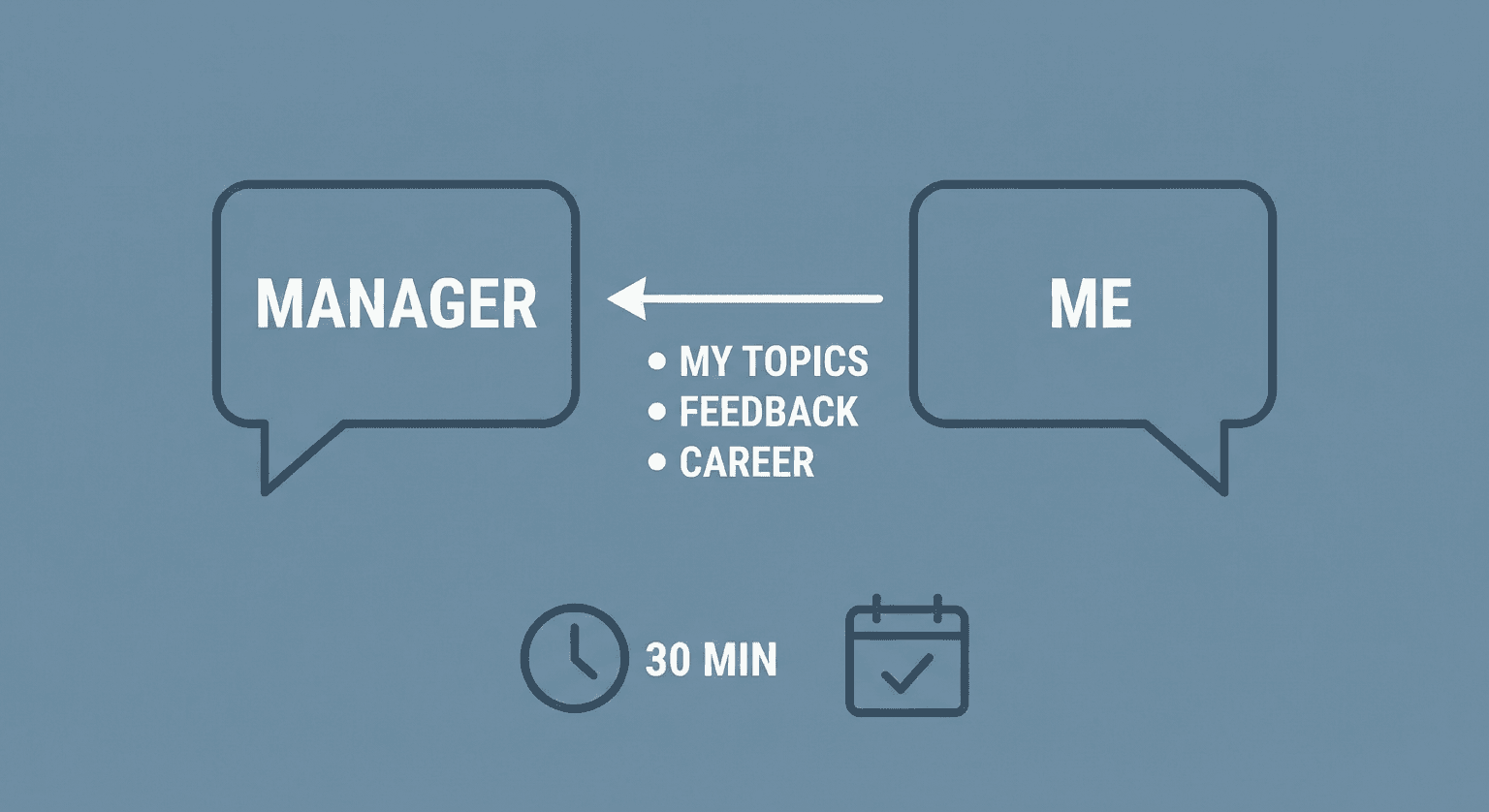
The shift happened when I realized that the 1-on-1 isn't my manager's meeting. It's mine. They have other ways to get status updates. The 1-on-1 is my dedicated time to get what I need from the relationship.
What I Stopped Doing
Status Updates
My manager can read Jira. They can look at the sprint board. They can review my pull requests. Using 1-on-1 time for "I finished task X and started task Y" wastes the only recurring meeting where I have my manager's undivided attention.
If they need a status update, I send it in writing before the meeting. That frees up the conversation for things that actually require dialogue.
Waiting for Them to Drive
If I show up without an agenda, my manager fills the time with whatever's on their mind. That might be useful, but it's not what I need. I own the agenda. I come prepared.
Only Talking About Work
The best managers I've had wanted to understand me as a person, not just an engineer. What motivates me. What frustrates me. Where I want to be in two years. Those conversations build the kind of trust that makes everything else work better.
What I Do Instead
I Come With Topics
Before every 1-on-1, I write down 2-3 things I want to discuss. Not tasks. Topics. Things like:
- "I'm struggling with the ambiguity on Project X. Can we talk about how to get clarity on the requirements?"
- "I've been thinking about moving toward more system design work. What opportunities do you see?"
- "The on-call rotation has been brutal this quarter. Can we discuss how to make it more sustainable?"
These are the kinds of problems that email can't solve. They need conversation, context, and trust.
I Ask for Feedback Directly
Most managers won't give you honest feedback unless you ask for it specifically. "How am I doing?" gets a vague "great!" every time. Instead, I ask targeted questions:
- "In last week's design review, was there anything I could have communicated more clearly?"
- "Compared to other engineers at my level, where do you think my biggest gap is?"
- "If you had to pick one thing for me to improve this quarter, what would it be?"
These questions make it easier for my manager to be honest. They're specific enough that a generic "you're doing fine" doesn't work as an answer.
I Share Context They Don't Have
My manager doesn't see everything I see. They don't know that the new API integration is more fragile than it looks. They don't know that the junior engineer on the team is struggling but hasn't said anything. They don't know that the timeline we committed to is at risk because of a dependency no one accounted for.
I share these observations early. Not as complaints, but as context that helps them make better decisions. "I wanted to flag something: the dependency on Team X's API is taking longer than expected. We have three options, and I want to make sure you're aware before the next planning meeting."
I Talk About My Career
My manager can't advocate for my promotion if they don't know what I'm working toward. Once a quarter, I bring up career growth explicitly:
- "Here's what I think the expectations are for the next level. Am I reading them correctly?"
- "I've been doing a lot of mentoring this quarter. Is that visible to the people who make promotion decisions?"
- "What would it take for me to get a project with more scope?"
These conversations feel uncomfortable at first. But every engineer I know who's been promoted consistently credits having open career conversations with their manager.
I Give Feedback Upward
The best managers want feedback, too. When something is working, I say so. "The way you handled the re-org communication was really good. The team felt informed instead of blindsided." When something isn't working, I say that too, but constructively. "The weekly team meeting has been running long. Could we move status updates to async and use the meeting for discussions that need real-time conversation?"
Upward feedback is a gift. It helps your manager improve, and it signals that you take the relationship seriously.
The Structure
Here's roughly how I structure a typical 1-on-1:
First 5 minutes: Check-in. How are things going generally? Anything unusual this week? This is the human connection part.
Next 15 minutes: My topics. The 2-3 things I prepared. This is where the real value is.
Next 5 minutes: Their topics. Anything they need from me. Organizational updates, feedback, asks.
Last 5 minutes: Action items. What did we decide? What's the follow-up? I write these down immediately. Nothing kills trust faster than having the same conversation three weeks in a row because no one wrote down the action items.
When Things Aren't Working
Sometimes the manager relationship just isn't clicking. Before assuming the worst, I try to diagnose:
Are we meeting consistently? If 1-on-1s keep getting canceled, that's a signal. I name it: "I've noticed we've rescheduled the last three weeks. Can we find a time that's more protected?"
Am I getting useful feedback? If every 1-on-1 ends with "you're doing great" and no specifics, I ask harder questions. If I still get nothing, I seek feedback from other senior engineers and skip-levels.
Do I trust them? If I can't be honest in 1-on-1s, the meeting is performative. Trust takes time to build, but if it's not building after several months, that's worth reflecting on.
The 1-on-1 is one of the few meetings where the return on investment is entirely up to you. Preparing for 10 minutes before each one has been one of the highest-leverage habits of my career.
Related posts
What I Look For When Evaluating a New Role
My framework for evaluating new engineering roles that goes beyond compensation and title. What actually matters for long-term career growth.
How I Communicate Technical Tradeoffs to Non-Engineers
The ability to explain technical decisions in terms that non-engineers care about is one of the most valuable skills a senior engineer can develop.
What I've Learned From Sitting in on Design Reviews
Design reviews aren't just for designers. As an engineer who regularly participates in them, I've gained perspectives that make me better at building products.