How I Communicate Technical Tradeoffs to Non-Engineers
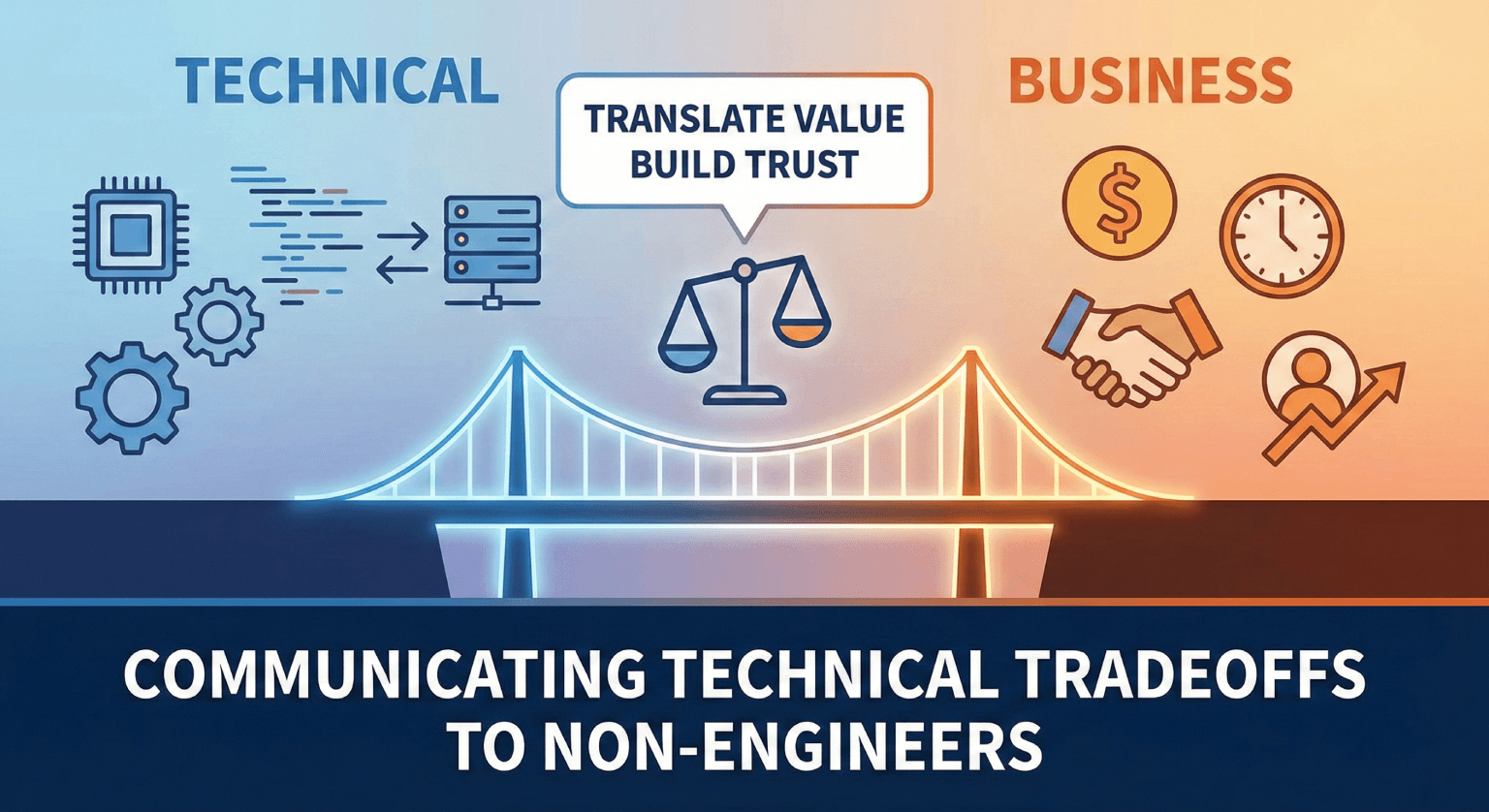
Early in my career, I'd explain technical decisions using technical language. "We should use a persistent cache with LRU eviction because the API latency at p95 is too high." My manager would nod politely. Nothing would change.
The problem wasn't that my recommendation was wrong. The problem was that I was speaking a language my audience didn't speak. And more importantly, didn't need to speak.
The Framework I Use
Every technical tradeoff can be expressed in terms non-engineers care about: time, money, risk, and user experience. I translate everything into those four dimensions.
Technical framing:
"We need to refactor the data layer from SQLite to Room."

Business framing:
"Our app crashes for about 2% of users when they open their saved items.
Fixing the underlying cause takes about a week. After that, this category
of crash goes away permanently, and building new features in this area
becomes 30-40% faster."
The second version answers the questions a PM, designer, or executive actually has: Who does this affect? How long will it take? What do we get?
Translating Common Tradeoffs
Speed vs. Quality
Technical version: "We can ship this without unit tests, but we'll accumulate tech debt."
Business version: "We can ship this a week earlier. The tradeoff is that bugs in this area will take longer to find and fix. Based on similar features, I'd estimate 2-3 extra bug-fix cycles over the next quarter, each taking a few days. So we save a week now but likely spend more time total."
Build vs. Buy
Technical version: "We could build our own analytics pipeline or use a third-party service."
Business version: "Building our own gives us full control and costs about 6 weeks of engineering time. Using a service costs $X per month, takes a week to integrate, but means we depend on a vendor for a critical system. If the vendor has an outage, our analytics go dark and we can't make data-driven decisions until it's resolved."
Migration vs. Incremental Improvement
Technical version: "We should migrate from the legacy API to the new GraphQL API."
Business version: "Right now, adding a new screen that shows user data takes about 3 days because of how our current system works. After this migration, it would take about 1 day. The migration itself is 4 weeks. So if we're building more than 6 new screens in the next year, the migration pays for itself."
The Techniques That Work
Use Analogies From Their World
When explaining caching to a product manager, I don't talk about cache invalidation strategies. I say: "It's like keeping a printed copy of a report on your desk instead of walking to the filing cabinet every time. Faster, but you might be reading yesterday's numbers."
Quantify Everything
"This will be slow" means nothing. "This will add 800ms to the screen load time, which based on our data correlates with a 5% drop in completion rate" means everything. Numbers create urgency. Vague concerns create nothing.
Present Options, Not Recommendations
Instead of "we should do X," I present options with tradeoffs:
Option A: Quick fix (2 days)
- Solves the immediate problem
- Doesn't address the root cause
- We'll likely see similar issues in 2-3 months

Option B: Proper fix (2 weeks)
- Solves the root cause
- Prevents similar issues going forward
- Delays the feature we planned for this sprint

Option C: Hybrid (1 week)
- Quick fix now, scheduled proper fix next sprint
- Feature stays on track
- Requires commitment to actually do the follow-up work
This respects the decision-maker's autonomy. They have context I don't have about business priorities. My job is to make sure they understand the technical implications of each option.
Tell the Story of What Happens Next
Non-engineers think in narratives, not architectures. Instead of describing the system, describe what happens:
"A user opens the app. Right now, we fetch everything from the server, which takes 3 seconds on a typical connection. With this change, we show them cached data instantly and update it in the background. They see the screen in under a second. If the update has new data, the screen refreshes smoothly. If not, nothing changes."
This is more compelling than "we implement an optimistic UI pattern with background sync."
Common Mistakes
Over-explaining. When a non-engineer asks "why is this hard?", they don't want a 20-minute architecture lecture. They want a one-sentence summary. "The data lives in three different systems that don't talk to each other, so we have to reconcile them manually." Done.
Using fear. "If we don't fix this, the system will crash." Maybe true, but crying wolf erodes trust. Instead: "This hasn't caused problems yet, but as we grow, the risk increases. I'd rather fix it proactively than reactively."
Assuming they don't care. Non-engineers care deeply about technical quality. They just need it framed in terms of outcomes. "Clean code" means nothing to them. "Code that's easier to change, so we can ship features faster" means a lot.
Why This Matters
The engineers who get promoted to staff and principal levels aren't necessarily the best coders. They're the ones who can influence decisions. And you can't influence decisions if you can't communicate in terms your audience understands.
Every time I explain a technical tradeoff clearly, I'm building trust. Trust that engineering is making good decisions. Trust that when we say something is important, it actually is. That trust is what gives engineering a seat at the table when priorities are set.
Related posts
What I've Learned From Sitting in on Design Reviews
Design reviews aren't just for designers. As an engineer who regularly participates in them, I've gained perspectives that make me better at building products.
How to Work Effectively With Product Managers as an Engineer
The engineer-PM relationship is one of the most important dynamics on any product team. Here's how I've learned to make it productive instead of adversarial.
What I Wish I Knew Before My First Big Production Incident
Production incidents are inevitable. How you handle them defines your growth as an engineer. Here's what I learned from my first major one.