How I Went From Writing Features to Owning Systems
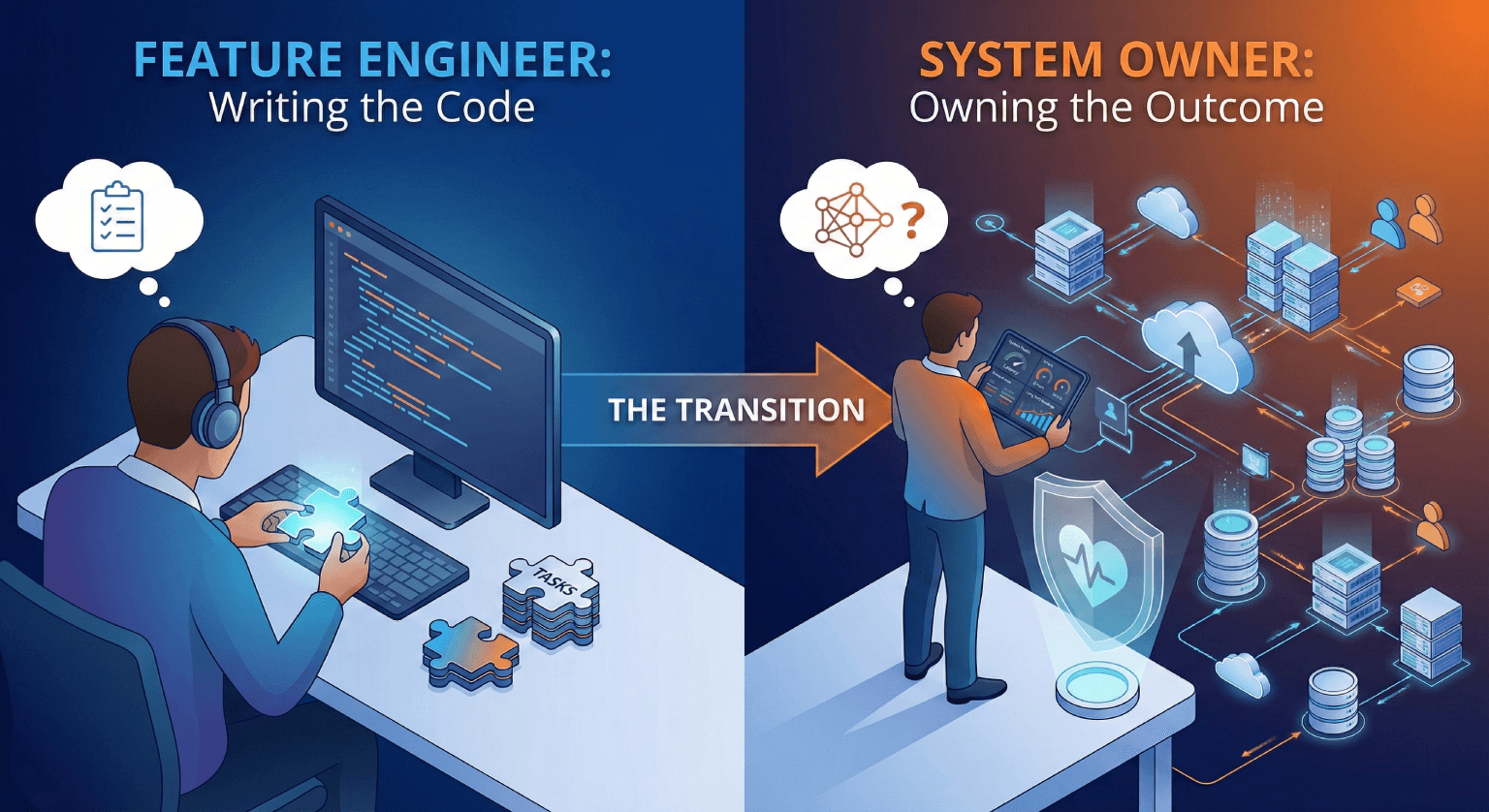
For the first few years of my career, my job was to build features. Someone would hand me a spec, I'd write the code, it would go through review, and it would ship. The scope was clear. The feedback loop was fast. I was productive.
Then one day, my manager said: "We need someone to own the ad delivery pipeline." Not build a feature in it. Own it. That meant being responsible for its reliability, performance, evolution, and the decisions about what gets built next.
That transition changed everything about how I work.
What "Owning" Actually Means
Owning a system means you're the person people come to when something goes wrong. When the pipeline has a production issue at midnight, you're the one who gets paged. When another team needs to integrate with it, you're the one who defines the interface. When leadership asks "can we do X?" you're the one who answers.
It also means you're responsible for the long-term health of the system, not just the current sprint's deliverables:
- Technical roadmap. What needs to change to support the next year of product development?
- Operational health. Is the system observable? Are alerts meaningful? Is the on-call experience sustainable?
- Documentation. Can someone new understand the system without asking you 50 questions?
- Debt management. What shortcuts have accumulated? Which ones matter?
What Changed in My Day-to-Day
I Stopped Waiting for Tasks
As a feature engineer, work came to me through tickets. As a system owner, I generate work. I look at metrics, find problems, propose solutions, and prioritize them against product asks.
This was the hardest adjustment. Nobody tells you what to do. You have to figure out what matters most and advocate for it.
I Started Thinking in Quarters, Not Sprints
Features ship in sprints. Systems evolve over quarters. I learned to balance short-term feature requests with long-term system health.
A product manager might ask for a new ad format that requires significant pipeline changes. My job is to say: "We can do this, but the pipeline needs refactoring first. Here's a plan that delivers the feature in 6 weeks instead of 3, but leaves us in a better position for the next 5 features after that."
I Became the Translator
System owners sit between product and infrastructure. Product wants features. Infrastructure wants stability. Both are right. My job is to translate between the two.
"The product team wants real-time experiment results. The data pipeline processes in 15-minute batches. Here's a proposal for a streaming layer that gives us 2-minute latency without rebuilding the batch pipeline."
I Got Comfortable With Incomplete Information
Feature engineering has clear inputs and outputs. System ownership is full of ambiguity. Is this metric moving because of our change or because of seasonality? Is this design good enough or should we invest more time? Should we build this ourselves or adopt an existing solution?
The answer is often "we don't know, but here's the best decision we can make with what we have."
The Skills That Mattered Most
Debugging production systems. Not debugging code in an IDE. Debugging a distributed system using logs, metrics, and traces to find why something broke at 3 AM on a Sunday.
Writing design documents. Clear, concise proposals that explain the problem, the options, the trade-offs, and the recommendation. Not 20-page novels. One or two pages that the team can read in 10 minutes and make a decision.
Having difficult conversations. "We need to slow down feature work to address reliability." "Your proposed feature doesn't fit the system's architecture and here's why." "I made a mistake in the design and we need to change course."
Saying "I need help." Owning a system doesn't mean being the only person who can work on it. Building a team around the system, sharing context, and delegating effectively is how system ownership scales.
Advice for Engineers Making This Transition
- Volunteer for on-call. Nothing teaches you a system faster than being responsible when it breaks.
- Read the metrics before the code. Understand what the system does from the outside before diving into how it does it.
- Document what you learn. The docs you write during onboarding become the docs the next person reads.
- Own a small system first. A single service, a single pipeline, a single library. Build the muscles before taking on something complex.
- Accept that you'll write less code. Your impact shifts from lines written to decisions made. That's not a demotion. It's a promotion.
Related posts
What I Wish I Knew Before My First Big Production Incident
Production incidents are inevitable. How you handle them defines your growth as an engineer. Here's what I learned from my first major one.
How I Think About Technical Debt in High-Velocity Teams
Tech debt isn't inherently bad. It's a tool. The problem is when teams accumulate it unconsciously, without tracking it or paying it down strategically.
The Difference Between Shipping Fast and Shipping Well (And When Each Matters)
Speed and quality aren't always at odds. But when they are, knowing which one to optimize for is one of the most important judgment calls an engineer can make.