State Management in Jetpack Compose: What Works in Practice
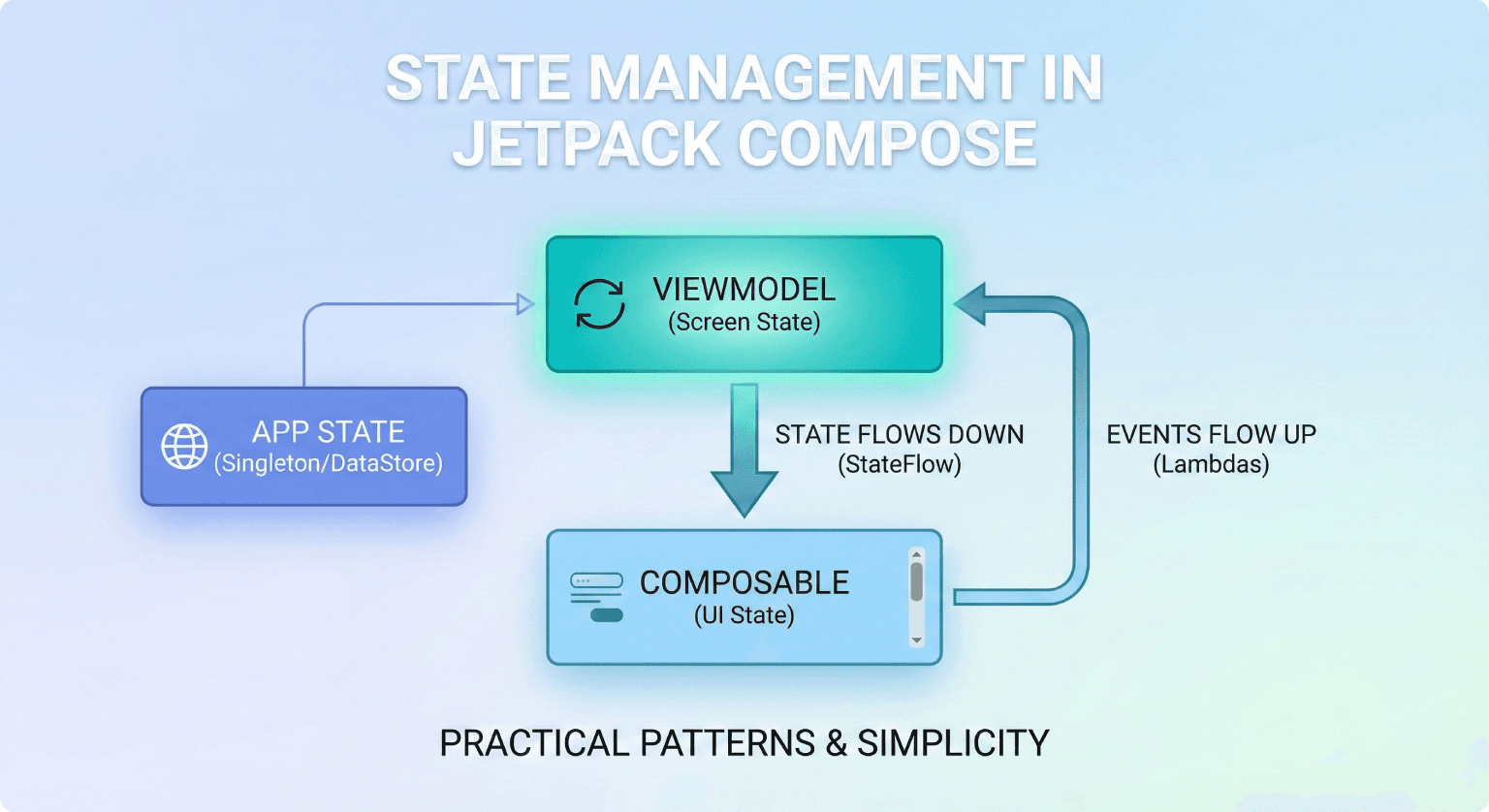
State management in Compose is deceptively simple on the surface. remember, mutableStateOf, done. But as your app grows, the choices you make about where state lives and how it flows determine whether your codebase stays manageable or becomes a tangled mess.
Key Takeaways
- Not all state belongs in the ViewModel - UI state and business state are different.
StateFlow+collectAsStateWithLifecycleis the most reliable pattern for production apps.- Derived state reduces bugs by eliminating state synchronization problems.
- State holders are underused and solve real problems.
Where State Should Live
I categorize state into three buckets:
| State Type   | Where It Lives          | Example                           |
|--------------|-------------------------|-----------------------------------|
| UI state     | Composable (`remember`) | Scroll position, text field focus |
| Screen state | ViewModel (`StateFlow`) | Loading, error, data              |
| App state    | Singleton / DataStore   | Auth token, theme preference      |
The mistake I see most often: putting everything in the ViewModel. A text field's focus state doesn't need to survive configuration changes. A scroll position doesn't need to be in a StateFlow. Keep UI-only state in the composable.
The Pattern I Use for Every Screen
// 1. Define the state
data class ProfileUiState(
    val user: User? = null,
    val isLoading: Boolean = true,
    val error: String? = null,
    val isEditing: Boolean = false
)

// 2. Sealed interface for events
sealed interface ProfileEvent {
    data object EditClicked : ProfileEvent
    data class NameChanged(val name: String) : ProfileEvent
    data object SaveClicked : ProfileEvent
}

// 3. ViewModel exposes state, handles events
class ProfileViewModel @Inject constructor(
    private val userRepo: UserRepository
) : ViewModel() {

    private val _uiState = MutableStateFlow(ProfileUiState())
    val uiState: StateFlow<ProfileUiState> = _uiState.asStateFlow()

    fun onEvent(event: ProfileEvent) {
        when (event) {
            is ProfileEvent.EditClicked ->
                _uiState.update { it.copy(isEditing = true) }
            is ProfileEvent.NameChanged ->
                _uiState.update { it.copy(user = it.user?.copy(name = event.name)) }
            is ProfileEvent.SaveClicked -> saveProfile()
        }
    }

    private fun saveProfile() {
        viewModelScope.launch {
            _uiState.update { it.copy(isLoading = true) }
            userRepo.updateUser(_uiState.value.user!!)
                .onSuccess { _uiState.update { it.copy(isEditing = false, isLoading = false) } }
                .onFailure { e -> _uiState.update { it.copy(error = e.message, isLoading = false) } }
        }
    }
}

// 4. Composable collects and renders
@Composable
fun ProfileScreen(viewModel: ProfileViewModel = hiltViewModel()) {
    val state by viewModel.uiState.collectAsStateWithLifecycle()
    ProfileContent(state = state, onEvent = viewModel::onEvent)
}
This pattern scales to every screen I've built. The composable is stateless and testable. The ViewModel is the single source of truth. Events flow up, state flows down.
Derived State: Eliminate Synchronization Bugs
One of the most common bugs I see is keeping two pieces of state that should be derived from each other:
// Bug-prone: two sources of truth
var items by mutableStateOf(emptyList<Item>())
var itemCount by mutableStateOf(0) // Will this always match items.size?

// Better: derive it
var items by mutableStateOf(emptyList<Item>())
val itemCount: Int get() = items.size
In ViewModels, I use combine and map to derive state from multiple flows:
val uiState: StateFlow<SearchUiState> = combine(
    searchQuery,
    allItems,
    selectedFilter
) { query, items, filter ->
    val filtered = items
        .filter { it.matchesFilter(filter) }
        .filter { it.matchesQuery(query) }
    SearchUiState(
        items = filtered,
        resultCount = filtered.size,
        isFiltered = filter != Filter.All
    )
}.stateIn(viewModelScope, SharingStarted.WhileSubscribed(5000), SearchUiState())
No synchronization needed. The state is always consistent because it's computed from a single source.
State Holders for Complex UI Logic
When a composable has complex UI logic that doesn't belong in the ViewModel, I use a state holder:
class SearchBarState(
    initialQuery: String = ""
) {
    var query by mutableStateOf(initialQuery)
        private set
    var isExpanded by mutableStateOf(false)
        private set
    var suggestions by mutableStateOf(emptyList<String>())
        private set

    fun onQueryChange(newQuery: String) {
        query = newQuery
        isExpanded = newQuery.isNotEmpty()
    }

    fun onSuggestionSelected(suggestion: String) {
        query = suggestion
        isExpanded = false
    }

    fun collapse() {
        isExpanded = false
    }
}

@Composable
fun rememberSearchBarState(initialQuery: String = "") =
    remember { SearchBarState(initialQuery) }
This keeps the composable clean, the ViewModel focused on business logic, and the UI logic testable without a ViewModel.
What I Avoid
MutableLiveData in new code. StateFlow works better with Compose and coroutines. LiveData was built for the View system.
Channel for UI events. I used to use Channel for one-shot events like showing a snackbar. Now I model them as state with a consumed flag or use SharedFlow with care. Channels can lose events during configuration changes.
Storing navigation state in the ViewModel. Navigation is a side effect, not state. I trigger navigation via callbacks, not by observing ViewModel state.
Final Thought
The best state management approach is the one that makes bugs obvious. If your state can get out of sync, it will. If your state is derived from a single source, it can't. Start simple, use StateFlow, derive what you can, and only reach for more complex solutions when the simpler ones genuinely don't work.
Related posts
Jetpack Compose Architecture Patterns That Scale
Practical architecture patterns for Jetpack Compose that work in real production Android apps at scale, covering state hoisting, navigation, and modularity.
How I Think About Performance Bottlenecks in Android
A systematic approach to finding and fixing performance bottlenecks in Android apps - from identifying symptoms to measuring impact.
What I Focus On When Performance Actually Matters in Android Apps
Performance optimization in Android is about knowing what to measure and when to act. My practical approach to profiling, reducing jank, and shipping fast apps.