What I've Learned Shipping Monetization Code to Hundreds of Millions of Users
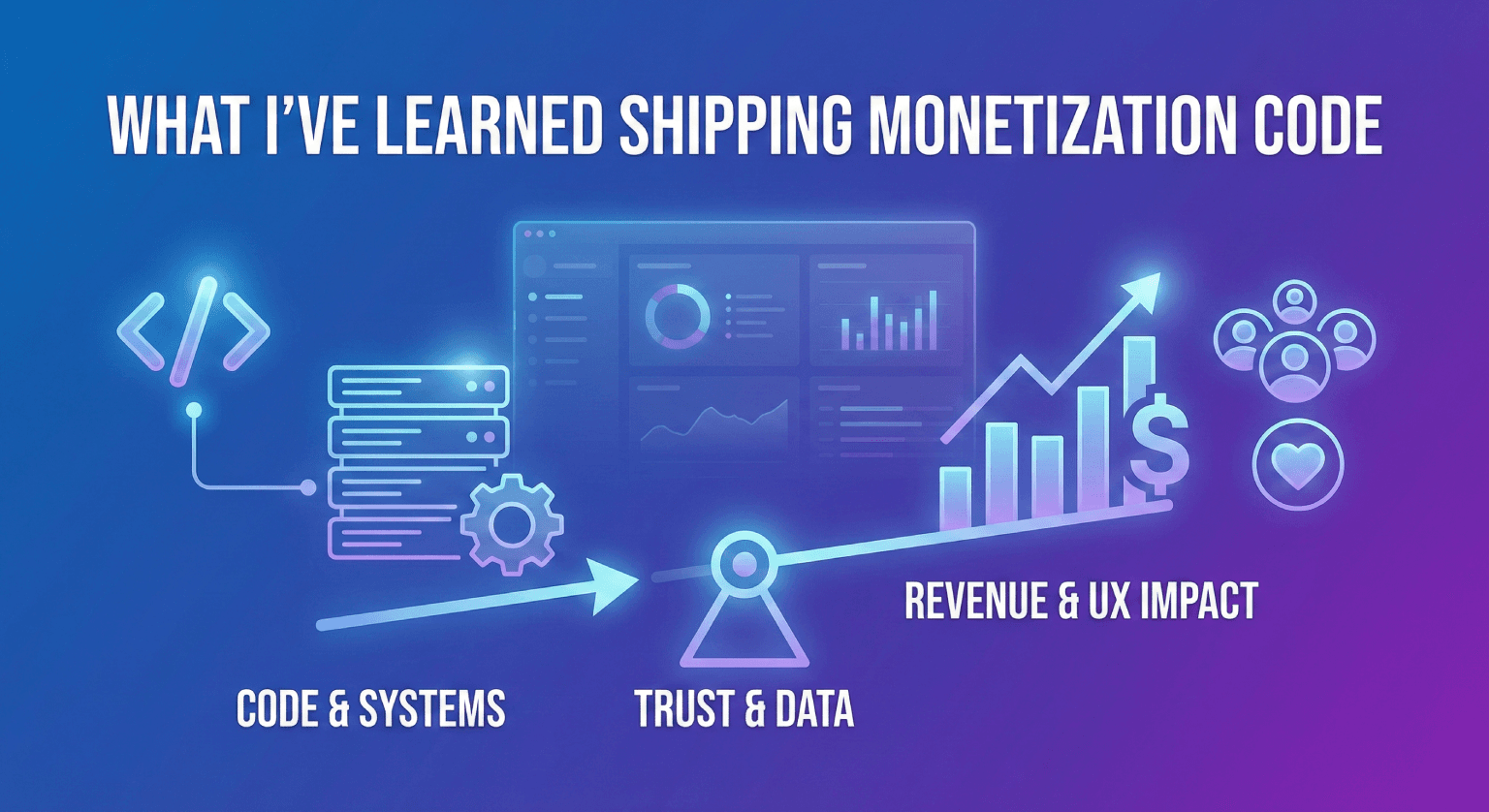
There's a particular feeling you get the first time you ship code that affects revenue on a product with hundreds of millions of users. It's not excitement. It's a very specific kind of weight. Your pull request isn't just code anymore. It's a lever that moves real money, touches real people, and has consequences that show up in dashboards within minutes of landing.
I've been in that position enough times now that the weight has become familiar. Not lighter, just familiar. And along the way, I've picked up lessons that nobody taught me in school, nobody wrote in a textbook, and nobody mentioned in the interview that got me the job.
The Code Is the Easy Part
When I started working on monetization systems, I assumed the hard part would be the code. Complex algorithms, tricky data structures, performance-critical rendering paths. And yes, those things matter. But the truly hard part is everything around the code.
The hard part is understanding why a 0.2% change in ad load rate matters. It's knowing that a metric moving sideways for three days doesn't mean your experiment is neutral, it might mean your logging is broken. It's realizing that the stakeholder asking for "just one more ad slot" doesn't understand the second-order effects on retention, and it's your job to make that case clearly.
// This looks like a simple config change.
// It is not a simple config change.
object AdLoadConfig {
    val baseAdFrequency: Int = 5  // One ad every N content items

    // Changing this from 5 to 4 increases ad load by 25%.
    // That 25% doesn't translate linearly to revenue.
    // At some point, more ads = less session time = fewer total impressions.
    // The optimal point is different for every market, every user segment,
    // and every content type. It shifts seasonally.
    // This single integer has been the subject of more meetings
    // than most entire features.
}
The engineers who thrive in monetization aren't the ones who write the cleverest code. They're the ones who understand the full picture: the business model, the user psychology, the measurement infrastructure, and the organizational dynamics. The code is just how you express that understanding.
Measure Twice, Ship Once
In product engineering, you can often ship something, see if users like it, and iterate. In monetization engineering, a bad ship can cost real money before you even notice something is wrong.
I learned this lesson early. I shipped a change to impression logging that had a subtle bug: it was double-counting impressions under a specific race condition that only triggered when the user scrolled at a particular speed during a network retry. In testing, it never appeared. In production, with hundreds of millions of users, it appeared thousands of times per minute.
The result wasn't a crash. It wasn't a visual bug. It was inflated impression numbers that made a mediocre experiment look like a winner. We almost shipped the experiment to 100% based on those numbers. A data scientist caught the discrepancy during a routine quality check. If she hadn't, we would have rolled out a change that degraded the user experience while our dashboards told us everything was fine.
Since then, I follow a personal rule: every monetization change gets validated from at least two independent data sources before I trust it.
class ImpressionValidator(
    private val clientLogger: ClientImpressionLogger,
    private val serverLogger: ServerImpressionLogger
) {
    fun validateImpressionCounts(
        experimentId: String,
        window: TimeWindow
    ): ValidationResult {
        val clientCount = clientLogger.getCount(experimentId, window)
        val serverCount = serverLogger.getCount(experimentId, window)

        val discrepancy = Math.abs(clientCount - serverCount).toDouble() /
            maxOf(clientCount, serverCount, 1).toDouble()

        return when {
            discrepancy > 0.10 -> ValidationResult.Alert(
                "Impression discrepancy of ${(discrepancy * 100).toInt()}% " +
                "between client ($clientCount) and server ($serverCount)"
            )
            discrepancy > 0.05 -> ValidationResult.Warning(
                "Minor impression discrepancy: ${(discrepancy * 100).toInt()}%"
            )
            else -> ValidationResult.Healthy
        }
    }
}
Small Changes, Big Consequences
In most areas of software engineering, a one-line change is low risk. In monetization, a one-line change can move millions of dollars.
I once watched a teammate change a default timeout from 3 seconds to 5 seconds on an ad fetch. The reasoning was sound: some ad networks were slow to respond, and we were timing out before they could return a fill. A longer timeout would improve fill rate.
What actually happened: the longer timeout blocked the content rendering pipeline on slow networks. Users on 3G connections saw a blank space for 2 extra seconds while the ad request completed. Session duration dropped by 4% in emerging markets. The fill rate went up, but total impressions went down because users were leaving sooner.
The fix was simple. Make the ad fetch non-blocking so content renders immediately and the ad fills in when ready. But the lesson was bigger: in monetization, you can never change one variable in isolation. Everything is connected.
// Before: blocking ad fetch
suspend fun loadFeedItem(position: Int): FeedItem {
    val content = contentRepository.getItem(position)
    if (shouldShowAd(position)) {
        val ad = adFetcher.fetch(timeout = 5000) // Blocks content
        return FeedItem.WithAd(content, ad)
    }
    return FeedItem.ContentOnly(content)
}

// After: non-blocking ad fetch
suspend fun loadFeedItem(position: Int): FeedItem {
    val content = contentRepository.getItem(position)
    if (shouldShowAd(position)) {
        // Content renders immediately, ad fills in asynchronously
        val adDeferred = adFetcher.fetchAsync(timeout = 3000)
        return FeedItem.WithAdSlot(content, adDeferred)
    }
    return FeedItem.ContentOnly(content)
}
The Experiments That Teach You the Most Are the Ones That Fail
I've shipped dozens of monetization experiments. The ones I learned the most from are the ones that didn't work.
One experiment tried to increase revenue by showing higher-value ad formats to users who were deeply engaged in a session. The hypothesis was logical: engaged users are more tolerant of ads, so we can show them premium formats that generate more revenue per impression.
The experiment showed a 12% increase in revenue per impression. Ship it, right?
Not so fast. Retention metrics told a different story. The users we were targeting with premium ad formats were our most valuable users, the ones who came back every day, who spent the most time in the app. By showing them more aggressive ad formats, we were slowly training them to use the app less. D7 retention for that segment dropped by 0.8%.
A 0.8% retention drop doesn't sound like much. But compound it over months, across your most valuable user segment, and it dwarfs the revenue gain from the experiment. We killed it.
The lesson: short-term revenue gains that cost long-term retention are almost never worth it. The users you can monetize the hardest are the ones you can least afford to lose.
Code Reviews in Monetization Are Different
Code reviews for monetization changes carry a different weight than typical product reviews. I've been on both sides, as the author and the reviewer, and the bar is higher in ways that aren't immediately obvious.
A typical code review asks: Does this work? Is it clean? Does it handle edge cases?
A monetization code review adds: What happens if this metric moves 5% in the wrong direction? Is the logging correct? Are we measuring what we think we're measuring? What's the rollback plan? Have we considered the interaction with the three other experiments running on this surface?
// This code review comment saved us from a subtle but expensive bug.
//
// Reviewer: "This impression callback fires when the ad view is created,
// not when it's actually visible. If the user scrolls past before
// it enters the viewport, we'll count an impression that the user
// never saw. The MRC standard requires 50% pixel visibility for
// 1 continuous second. We need to defer this to the viewability
// tracker."
//
// Impact of the bug if shipped: ~8% impression inflation,
// which would have invalidated two concurrent experiments
// and potentially triggered an advertiser audit.

// Before (incorrect)
class AdViewHolder(view: View) {
    init {
        impressionTracker.logImpression(adId) // Too early
    }
}

// After (correct)
class AdViewHolder(view: View) {
    init {
        viewabilityTracker.observeViewability(view) { meetsThreshold ->
            if (meetsThreshold) {
                impressionTracker.logImpression(adId)
            }
        }
    }
}
I've learned to slow down during monetization code reviews. A 30-minute review that catches a logging bug saves more value than a week of feature development.
The On-Call Rotation Changes You
Every monetization engineer eventually gets the 2 AM page. Revenue dropped 15% in the last hour. Is it your code? Is it an upstream dependency? Is it a seasonal traffic pattern? Is it an advertiser pulling spend?
The first time this happens, you panic. The tenth time, you have a mental checklist:
- Is the data pipeline healthy? (Sometimes the revenue didn't drop. The dashboard is just delayed.)
- Did any experiment ramp up or down in the last 2 hours?
- Are there any ongoing incidents in upstream ad serving?
- Is there a traffic anomaly? (Major events, holidays, outages in specific regions.)
- Did someone push a config change?
class RevenueAlertTriager {
    fun triage(alert: RevenueAlert): TriageResult {
        // Step 1: Verify the data
        val pipelineHealth = dataPipeline.checkHealth()
        if (!pipelineHealth.isHealthy) {
            return TriageResult.DataIssue(pipelineHealth.details)
        }

        // Step 2: Check recent experiment changes
        val recentExperimentChanges = experimentService
            .getChangesInWindow(hours = 2)
        if (recentExperimentChanges.isNotEmpty()) {
            return TriageResult.ExperimentChange(recentExperimentChanges)
        }

        // Step 3: Check upstream health
        val upstreamHealth = adServingHealth.check()
        if (!upstreamHealth.allHealthy()) {
            return TriageResult.UpstreamIssue(upstreamHealth.degradedServices)
        }

        // Step 4: Check for traffic anomalies
        val trafficPattern = trafficAnalyzer.compareToBaseline()
        if (trafficPattern.isAnomaly) {
            return TriageResult.TrafficAnomaly(trafficPattern.details)
        }

        // Step 5: Check config changes
        val configChanges = configService.getRecentChanges(hours = 2)
        if (configChanges.isNotEmpty()) {
            return TriageResult.ConfigChange(configChanges)
        }

        return TriageResult.NeedsInvestigation
    }
}
The on-call rotation teaches you something that regular development doesn't: the systems you build will run without you, and they need to be understandable by someone who has never seen them before, at 2 AM, under pressure. That changes how you write code, how you name variables, how you structure logs, and how you document your systems.
You Will Get Comfortable with Ambiguity
Product engineers often have clear success criteria. Build the feature, ship it, measure adoption. Monetization engineering lives in gray areas.
Should you optimize for revenue per session or revenue per user per month? They point in different directions. Should you fill every ad slot or leave some empty to maintain content quality? The right answer depends on the market, the season, the user segment, and what your competitors are doing that week.
I've learned to get comfortable saying "I don't know yet, but here's how I'd find out." That usually means designing an experiment, picking the right metrics, setting a clear decision framework before the data comes in, and committing to following the data even when it contradicts my intuition.
The best monetization decisions I've made were the ones where I let go of my initial hypothesis and followed what the numbers were actually saying.
Trust Is Your Most Valuable Asset
This is the lesson that took me the longest to learn. In monetization engineering, trust is everything.
Trust from your data science partners that your logging is accurate. Trust from your product partners that you'll push back when a request would hurt the user experience. Trust from your leadership that you'll make the right call when the data is ambiguous. Trust from advertisers that the metrics you report are real.
Every time you ship clean data, catch a measurement bug before it reaches a dashboard, or kill an experiment that hits revenue targets but hurts users, you build trust. Every time you cut corners on validation, ignore a flaky metric, or let organizational pressure override your engineering judgment, you erode it.
Trust compounds. An engineer who has earned the trust of their data science and product partners gets more autonomy, more interesting problems, and more leverage to make the right decisions. An engineer who hasn't earned that trust gets micromanaged and second-guessed, regardless of how good their code is.
The Work Matters
I'll end with this. Monetization engineering sometimes gets dismissed as "just putting ads in the app." I understand why people think that. From the outside, it looks mechanical.
From the inside, it's one of the most consequential things you can work on. The revenue your code generates funds the product. It pays for the servers, the designers, the product managers, the other engineers. It keeps the app free for the billions of people who use it every day. When you do monetization well, nobody notices. The ads are relevant, the experience is smooth, and the business is healthy.
That's the goal. Not to maximize revenue. Not to minimize ads. To find the balance that keeps everything working, for the user, for the advertiser, and for the product. And to do it with code that's clean, metrics that are honest, and decisions that you can defend in the morning.
Related posts
Ad Injection Strategies for Short-Form Video Feeds: Timing, Frequency, and Impression Recovery
How ad injection works in short-form video feeds: timing heuristics, frequency capping, impression recovery, and the trade-offs behind monetization.
From Feature to Revenue: How Ad Delivery Decisions Get Made on Mobile
How ad delivery decisions actually get made on mobile: the stakeholders, trade-offs, and engineering reality behind every ad you see in a feed.
Why Ad Format Engineering Is One of the Hardest Problems in Mobile
Ad formats look simple from the outside, but behind each one is engineering complexity touching rendering, performance, measurement, and user experience.