Ad Injection Strategies for Short-Form Video Feeds: Timing, Frequency, and Impression Recovery
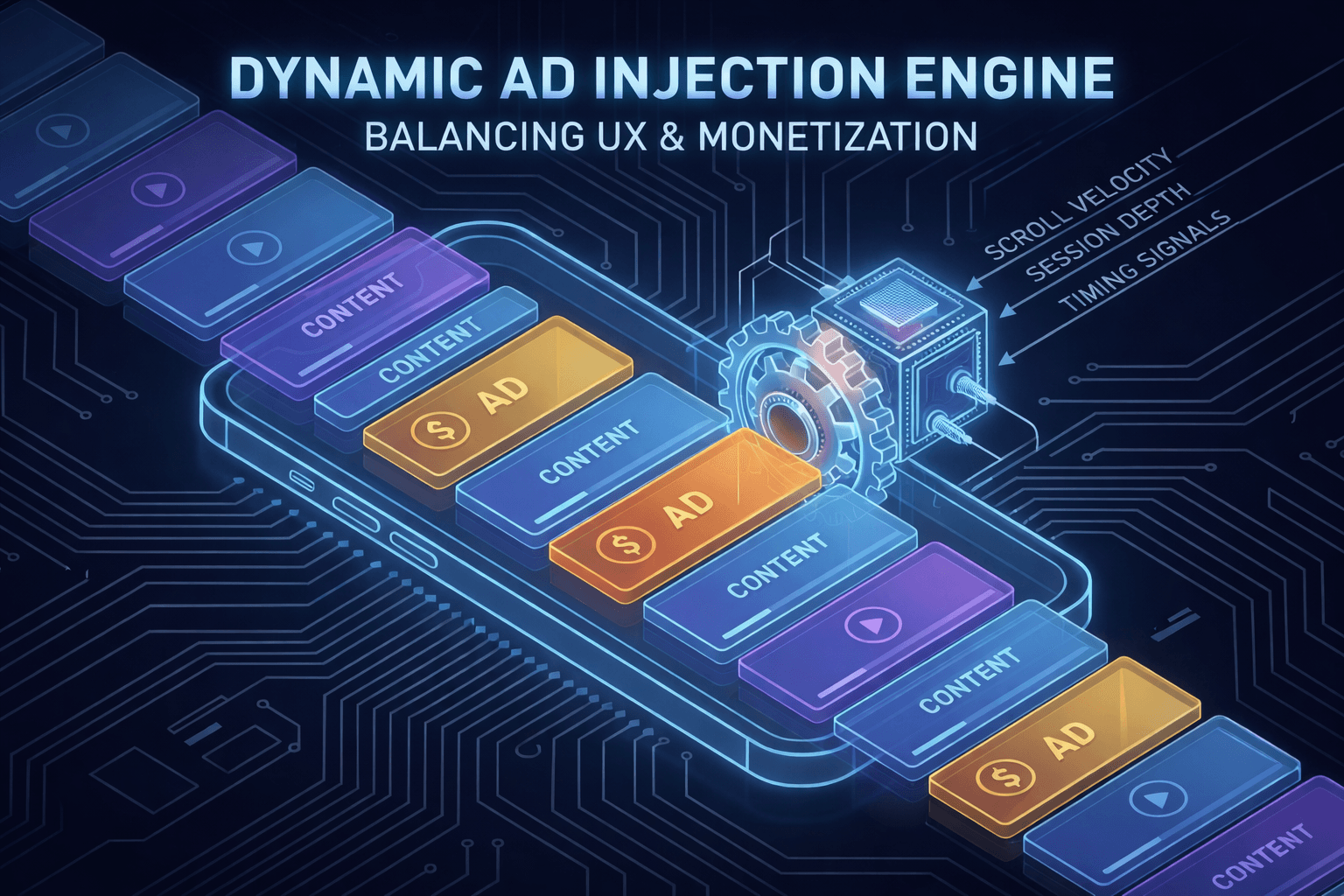
Short-form video feeds are one of the hardest surfaces to monetize well. Users scroll fast, attention spans are measured in seconds, and a poorly timed ad can tank engagement metrics. Having worked on monetization systems for short-form video, I've developed a mental model for thinking about ad injection that balances revenue goals with user experience.
Key Takeaways
- Ad injection is not just "insert ad every N posts" - it requires dynamic timing based on user behavior signals.
- Frequency capping prevents ad fatigue but must account for session length and scroll velocity.
- Impression recovery is critical when users scroll past ads too quickly for them to count.
- The best monetization systems are invisible to the user but measurable to the business.
The Core Problem
In a short-form video feed, content is consumed vertically in a rapid, swipe-driven pattern. Unlike traditional feed-based ads (where users scroll through cards), video ads compete directly with organic content for the same full-screen real estate. This creates a unique tension:
- Too many ads → users leave, session time drops, long-term retention suffers.
- Too few ads → revenue targets are missed, and the monetization team is under pressure.
- Wrong timing → even a well-made ad shown at the wrong moment feels intrusive.
The goal is to find the optimal injection strategy that maximizes revenue without degrading the user experience.
Timing: When to Show an Ad
The naive approach is positional: show an ad every N pieces of content. But this ignores how users actually consume short-form video.
Behavioral Signals That Matter
Instead of fixed positions, effective ad injection systems consider:
- Session depth: How many videos has the user watched in this session? Early in a session, users are more tolerant. Deep into a session, they're in a flow state and more sensitive to interruption.
- Scroll velocity: Is the user swiping rapidly (browsing) or watching videos fully (engaged)? Injecting during rapid scrolling wastes impressions.
- Content completion rate: Did the user watch the previous video to completion? A completed view suggests engagement - the next slot is a good candidate for an ad.
- Time since last ad: Simple but essential. A minimum cooldown period prevents back-to-back ads.
The Decision Function
At a high level, the injection decision looks like this:
fun shouldInjectAd(
    sessionDepth: Int,
    timeSinceLastAd: Duration,
    lastVideoCompletionRate: Float,
    scrollVelocity: Float
): Boolean {
    if (sessionDepth < MIN_WARMUP_VIDEOS) return false
    if (timeSinceLastAd < MIN_AD_COOLDOWN) return false
    if (scrollVelocity > RAPID_SCROLL_THRESHOLD) return false

    val engagementScore = lastVideoCompletionRate * COMPLETION_WEIGHT +
        (1f - scrollVelocity / MAX_VELOCITY) * VELOCITY_WEIGHT

    return engagementScore > AD_INJECTION_THRESHOLD
}
The key insight: ads should be injected when the user is engaged, not when they're disengaged. This is counterintuitive - you might think a bored user is more receptive to ads. But data consistently shows that engaged users tolerate ads better and are more likely to interact with them.
Frequency Capping: How Often is Too Often
Frequency capping operates at multiple levels:
Per-Session Caps
Limit the total number of ads a user sees in a single session. This prevents the scenario where a power user who watches 200 videos in a sitting gets bombarded with 40+ ads.
data class FrequencyConfig(
    val maxAdsPerSession: Int = 15,
    val maxAdsPerMinute: Int = 1,
    val minContentBetweenAds: Int = 4,
    val warmupVideos: Int = 3
)
Per-Day Caps
Even across sessions, there's a point of diminishing returns. Showing the same user 50 ads across 5 sessions in a day doesn't generate 50x the value - it generates fatigue and potentially churn.
Advertiser-Level Caps
Users shouldn't see the same advertiser's creative more than N times per day. This requires coordination between the ad selection layer and the frequency tracking system.
The Cap Stack
These caps form a stack - the most restrictive cap wins:
Session cap: 15 ads max
├── Per-minute cap: 1 ad max
├── Content gap cap: 4 videos between ads
├── Daily cap: 30 ads max
└── Advertiser cap: 3 per advertiser per day
Impression Recovery
Here's where it gets interesting. In short-form video, users can scroll past an ad before it meets the viewability threshold (typically 50% of pixels visible for 2+ seconds). This means the ad slot was "spent" but no impression was counted - the worst outcome for both revenue and user experience.
The Viewability Problem
Standard viewability rules for video ads:
- At least 50% of the ad's pixels must be on screen.
- The ad must play for at least 2 continuous seconds.
- Audio state may factor into premium impressions.
In a fast-scrolling feed, many ads fail these thresholds. The recovery strategy determines what happens next.
Recovery Strategies
Strategy 1: Backfill with a new ad
If the user scrolled past too quickly, mark the slot as "wasted" and inject a replacement ad sooner than the normal cadence would allow. This recovers the lost impression but risks higher ad density.
fun onAdScrolledPast(ad: AdUnit, viewDuration: Duration) {
    if (viewDuration < VIEWABILITY_THRESHOLD) {
        adState.markWasted(ad)
        adState.reduceNextCooldown(by = 0.5f) // inject sooner
        analytics.logEvent("ad_impression_missed", mapOf(
            "ad_id" to ad.id,
            "view_duration_ms" to viewDuration.inWholeMilliseconds
        ))
    }
}
Strategy 2: Sticky ad positioning
Some feeds implement a brief "sticky" behavior where the ad resists being scrolled away for the first second. This is controversial - it can feel janky if not implemented smoothly. The key is making the resistance feel like natural scroll physics, not a forced pause.
Strategy 3: Pre-roll warmup
Instead of inserting ads inline, show a brief ad before the next organic video starts playing. This guarantees viewability but changes the user's mental model of the feed.
Choosing the Right Strategy
In practice, I've found that Strategy 1 (backfill) works best for most feeds. It's the least disruptive to the user experience and can be tuned with server-side configuration. The cooldown reduction factor is the key lever - too aggressive and you get ad clusters, too conservative and you lose too much revenue.
Architecture Considerations
Client-Side vs Server-Side Injection
There are two schools of thought:
Server-side injection: The feed API returns a mixed list of organic content and ad slots. The client renders whatever it receives.
- Pros: Centralized control, easier A/B testing, consistent behavior across platforms.
- Cons: Harder to react to real-time user behavior, increased API complexity.
Client-side injection: The client fetches organic content and ads separately, then merges them based on local logic.
- Pros: Can react to scroll velocity, completion rates, and other real-time signals.
- Cons: Logic duplication across platforms, harder to maintain consistency.
The best approach is usually a hybrid: the server provides ad candidates and coarse timing hints, while the client makes the final injection decision based on real-time behavioral signals.
Server: "Here are 5 ad candidates. Target density: 1 per 5-7 videos."
Client: "Based on user behavior, I'll inject ad #2 after video #6
         and ad #4 after video #12."
Prefetching and Latency
Ad creatives (especially video) must be prefetched before the user reaches the ad slot. A blank or buffering ad is worse than no ad at all.
The prefetch window depends on scroll behavior:
- Normal scrolling: Prefetch 2-3 slots ahead.
- Rapid scrolling: Prefetch further ahead or skip injection entirely.
- Slow/stopped scrolling: Immediate next slot is sufficient.
Experimentation Framework
Every parameter in the ad injection system should be experimentable:
- Warmup period (3 videos vs 5 vs 7)
- Cooldown duration (30s vs 45s vs 60s)
- Engagement score threshold (0.4 vs 0.6 vs 0.8)
- Recovery aggressiveness (0.3x vs 0.5x vs 0.7x cooldown reduction)
- Frequency caps at every level
This means the injection logic needs to read from a remote config system and support per-user experiment assignment. The experimentation framework is arguably more important than any single injection strategy - it lets you iterate toward the optimal configuration for your specific user base.
Metrics That Matter
When evaluating an ad injection strategy, track these metrics:
| Metric              | What It Tells You                                        |
|---------------------|----------------------------------------------------------|
| Ad load rate        | Percentage of sessions that see at least one ad          |
| Impression yield    | Impressions per 100 organic views                        |
| Viewability rate    | Percentage of served ads that meet viewability threshold |
| Session time delta  | Change in session duration with ads vs without           |
| Scroll-through rate | How often users scroll past ads without viewing          |
| Revenue per session | Direct monetization efficiency                           |
| D7 retention delta  | Long-term impact on user retention                       |
The most important metric is the retention delta. Short-term revenue gains that cost you users are never worth it.
Lessons Learned
-
Start conservative. It's easier to increase ad density than to recover users lost to ad fatigue. Launch with lower caps and gradually increase.
-
Instrument everything. Every ad impression (or missed impression) should generate analytics events. You can't optimize what you can't measure.
-
Respect the scroll. Users in a fast-scroll state are telling you they haven't found what they want yet. Interrupting that search with an ad is the worst possible timing.
-
Think in sessions, not impressions. A session where the user sees 3 well-timed ads and watches for 20 minutes is worth more than a session where they see 8 ads and leave after 5 minutes.
-
Build for experimentation from day one. The optimal injection strategy varies by market, user segment, and content type. You need the infrastructure to test continuously.
Monetization engineering is a discipline where the technical challenge is matched by the product sensitivity. The best systems are the ones users never notice - they just enjoy the content, and the business metrics take care of themselves.
Related posts
From Feature to Revenue: How Ad Delivery Decisions Get Made on Mobile
How ad delivery decisions actually get made on mobile: the stakeholders, trade-offs, and engineering reality behind every ad you see in a feed.
Why Ad Format Engineering Is One of the Hardest Problems in Mobile
Ad formats look simple from the outside, but behind each one is engineering complexity touching rendering, performance, measurement, and user experience.
What I've Learned Shipping Monetization Code to Hundreds of Millions of Users
Hard-won lessons from writing code that directly impacts revenue at massive scale. What actually matters when your diff can move millions of dollars.