What Changes When Your App Has 100M+ Users
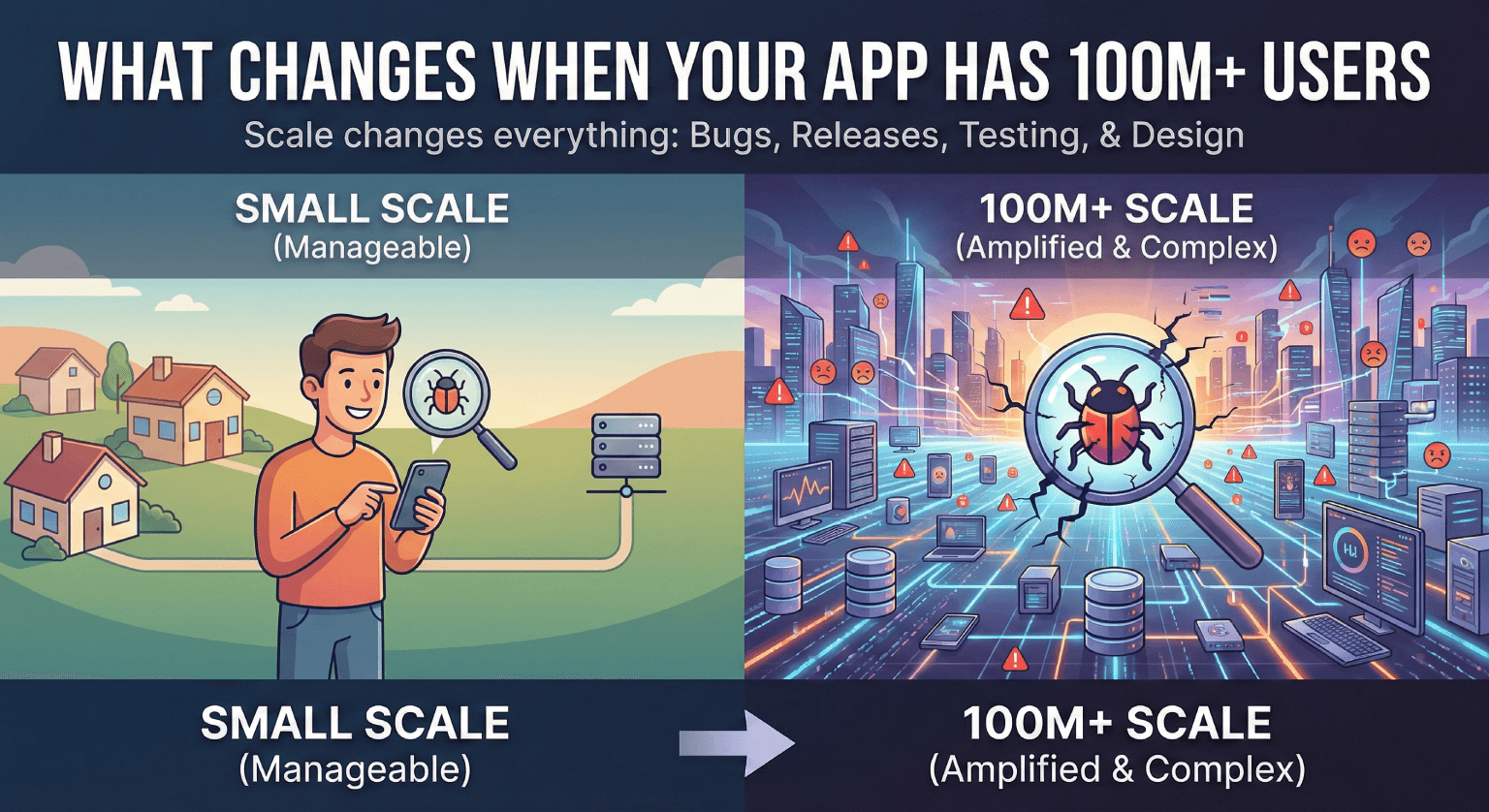
Working on an app with 100 million or more users isn't a scaled-up version of working on a small app. It's a different discipline entirely. The mental models that work at small scale break down, and new ones take their place.
Here's what actually changes.
Every Bug Is Amplified
A bug that affects 0.1% of sessions sounds negligible. At 100 million users, that's 100,000 people having a broken experience. Every day. If it's a crash, that's 100,000 one-star review candidates.
This changes how you think about edge cases. The "this will probably never happen" case happens thousands of times a day. Device fragmentation, network conditions, locale differences, accessibility settings, battery saver mode, custom ROMs. Every permutation that can occur, does occur, at scale.
// At small scale, this is fine
fun parseTimestamp(raw: String): Long {
    return SimpleDateFormat("yyyy-MM-dd").parse(raw)!!.time
}

// At scale, this crashes for:
// - Devices with non-Gregorian calendars
// - Locales where date parsing behaves differently
// - Malformed server responses
// - Null server responses during degraded mode
fun parseTimestamp(raw: String?): Long? {
    if (raw.isNullOrBlank()) return null
    return try {
        SimpleDateFormat("yyyy-MM-dd", Locale.US).parse(raw)?.time
    } catch (e: ParseException) {
        logger.warn("Failed to parse timestamp: $raw")
        null
    }
}
Releases Become Irreversible Events
At small scale, you can push a fix and most users get it within a day. At scale with mobile apps, a release takes weeks to fully roll out. Not everyone auto-updates. Some users are on older versions for months.
This means:
- You can't rely on "we'll fix it in the next release." The current release is the one that matters.
- Backward compatibility is non-negotiable. Your API must support the last N versions of the app.
- Feature flags are essential infrastructure. Every meaningful change should be toggleable without a code deploy.
You Can't Test Everything
At small scale, a QA team can tap through every flow before release. At scale, the number of permutations (device, OS version, locale, network, feature flag combination, A/B test group) is astronomically large.
Testing shifts from "verify everything works" to "verify the critical paths work, and build systems that detect when anything else breaks."
Monitoring, alerting, and automated rollback become more important than pre-release testing. Not a replacement for testing, but the primary safety net.
Performance Becomes a Feature
At small scale, "it works" is sufficient. At scale, "it works fast on a $150 phone with 3GB RAM on a spotty 3G connection" is the bar.
Performance optimization at scale also follows different rules. You can't optimize in isolation anymore. Every optimization has to be weighed against its impact on the entire system. Caching improves latency but increases memory. Prefetching improves perceived speed but increases bandwidth. Parallelization improves throughput but increases complexity.
Data Becomes the Product
At small scale, you look at analytics occasionally. At scale, data drives every decision. Which variant won the A/B test? What's the retention impact? How does this change affect different user segments differently?
This means your instrumentation needs to be as carefully designed as your features. A missing event, a mislabeled parameter, or an incorrect timestamp can invalidate weeks of experimental data.
You Start Designing for Failure
At small scale, you design for success. "If everything works correctly, here's what happens."
At scale, you design for failure. "When this service is down, what happens? When this data is stale, what does the user see? When this operation times out, how does the system recover?"
The shift from "if" to "when" is the defining mental model change of working at scale.
It's Worth It
Working at scale is harder. Every decision carries more weight. Every mistake has bigger consequences. But the flip side is also true: every improvement matters more. A 50ms reduction in load time across 100 million users adds up to years of saved human time. A 0.1% improvement in a success metric means hundreds of thousands of better experiences.
That's the trade: more pressure, more impact.
Related posts
Ad Injection Strategies for Short-Form Video Feeds: Timing, Frequency, and Impression Recovery
How ad injection works in short-form video feeds: timing heuristics, frequency capping, impression recovery, and the trade-offs behind monetization.
From Feature to Revenue: How Ad Delivery Decisions Get Made on Mobile
How ad delivery decisions actually get made on mobile: the stakeholders, trade-offs, and engineering reality behind every ad you see in a feed.
Why Ad Format Engineering Is One of the Hardest Problems in Mobile
Ad formats look simple from the outside, but behind each one is engineering complexity touching rendering, performance, measurement, and user experience.